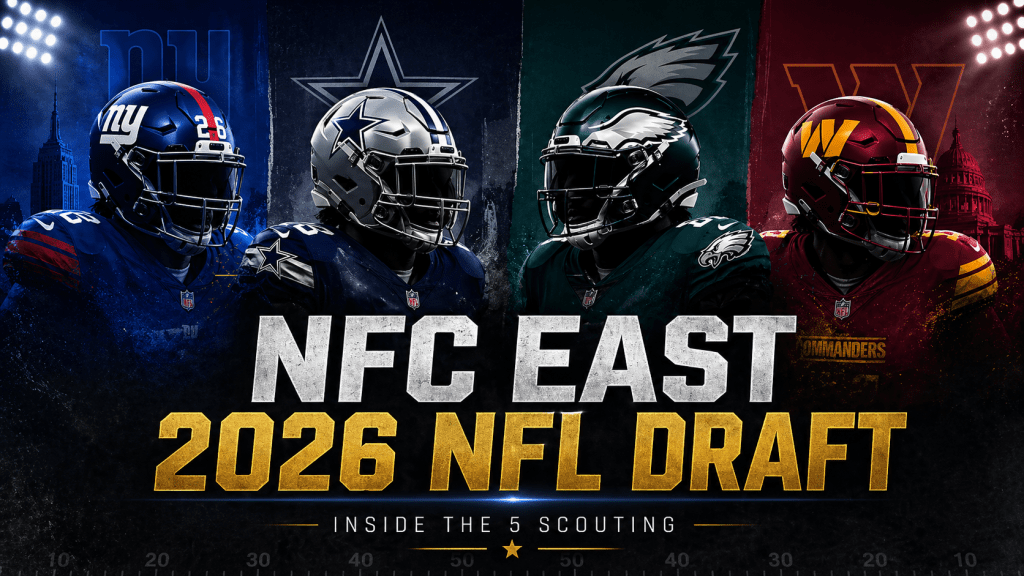
The NFC East came out of the 2026 NFL Draft with four very different approaches: the Giants attacked premium talent, the Cowboys rebuilt their defensive identity, the Eagles stayed aggressive, and the Commanders added versatile pieces around a changing roster.
The NFC East rarely does quiet draft weekends, and 2026 was no different.
Across the division, there was a clear theme: premium defensive traits, offensive support pieces, and front offices willing to move around the board. The Giants and Cowboys came away with the cleanest top-end hauls, the Eagles continued to build through aggression and roster flexibility, while the Commanders put together a solid, if slightly less explosive, class built around one of the more versatile defenders in the draft.
These are immediate post-draft grades. They are not career predictions. The grades reflect value, fit, positional importance, roster need, and the logic of the class as it stands today.
NFC East Draft Grades
| Team | Grade |
|---|---|
| New York Giants | A |
| Dallas Cowboys | A- |
| Philadelphia Eagles | B+ |
| Washington Commanders | B+ |
New York Giants — Grade: A
The Giants had the kind of draft that changes the athletic profile of a roster in one weekend.
New York opened with two top-10 selections, taking Ohio State linebacker/edge hybrid Arvell Reese at No. 5 and Miami offensive tackle Francis Mauigoa at No. 10. The class then added Tennessee corner Colton Hood at No. 37, Notre Dame wide receiver Malachi Fields at No. 74, and three sixth-rounders: Auburn defensive tackle Bobby Jamison-Travis, Illinois offensive lineman J.C. Davis, and BYU linebacker Jack Kelly.
The appeal of this class starts with the first two names. Reese gives the Giants a tone-setting front-seven piece with alignment versatility, closing speed, and pressure upside. Mauigoa, meanwhile, is the stabilising offensive line bet: big, powerful, and experienced enough to project as a long-term starter. That is exactly the kind of pairing you want at the top of a class — one pick that can tilt defensive structure, one pick that can protect the quarterback and reset the line of scrimmage.
Hood is the pick that pushes this from good to properly strong. Adding a corner in the early second gives the Giants another premium-position swing, and it makes sense given how aggressive this league has become with receivers and spacing. If Hood becomes a reliable starter, this class suddenly has three early-impact players at high-value spots.
There are some questions. Malachi Fields gives them size and vertical ability at receiver, but he may need development before becoming more than a role-specific target. The Day 3 group is more about depth and traits than immediate certainty. But that is fine when the top of the class has this much juice.
Best pick: Arvell Reese
Best value: Colton Hood
Biggest question: Did they do enough at wide receiver?
Overall: A premium, physical, high-upside class. The Giants came away looking more explosive, longer, and more dangerous on both sides of the ball.
Dallas Cowboys — Grade: A-
Dallas came into the draft clearly looking to reshape the defense, and that is exactly what they did.
The Cowboys selected Caleb Downs at No. 11, Malachi Lawrence at No. 23, Jaishawn Barham at No. 92, Drew Shelton at No. 112, Devin Moore at No. 114, LT Overton at No. 137, and Anthony Smith at No. 218. Dallas’ own write-up noted that five of the seven picks were on defense, while also referencing the team’s broader trade context involving Quinnen Williams and George Pickens.
This class is headlined by Downs, who might be the safest blue-chip defensive player in the draft. Dallas described him as a potential “quarterback of the defense,” with the flexibility to play safety, nickel, and potentially other secondary roles. That is exactly the kind of player who can clean up structure, create disguise, and give a defensive coordinator more answers against modern passing games.
Lawrence adds edge juice, Barham gives them a second-level defender with inside/outside flexibility, Moore brings length at corner, and Overton gives them more front multiplicity. This was not Dallas nibbling around the edges. This was Dallas making a bet that the defense needed to become longer, faster, and more flexible immediately.
The slight knock is on offensive balance. Shelton was the only meaningful offensive line addition, and Anthony Smith is more of a late explosive traits swing than a guaranteed offensive contributor. The Cowboys may have changed their defensive ceiling, but the offensive side of the ball still feels a little dependent on existing answers.
Still, this is a strong draft. Downs alone gives the class a very high floor, and the Lawrence-Barham-Moore-Overton run gives the defense multiple bites at impact contributors.
Best pick: Caleb Downs
Best value: Devin Moore
Biggest question: Did Dallas leave too much offensive support on the board?
Overall: A defensive identity draft with a true blue-chip headliner. The Cowboys got better, faster, and more multiple.
Philadelphia Eagles — Grade: B+
This was a very Eagles draft: aggressive, opportunistic, and tied into the wider roster-building picture rather than just the rookie list.
Philadelphia selected Makai Lemon at No. 20, Eli Stowers at No. 54, Markel Bell at No. 68, Cole Payton at No. 178, Micah Morris at No. 207, Cole Wisniewski at No. 244, Uar Bernard at No. 251, and Keyshawn James-Newby at No. 252. The Eagles also traded up from No. 23 to No. 20, and separately used picks to acquire veteran edge rusher Jonathan Greenard from Minnesota.
Lemon is the swing that defines the class. He gives Philadelphia another dynamic separator and run-after-catch piece in a passing game that already forces defences to declare their coverage early. The cost of moving up matters, but the player makes sense. Lemon is the kind of receiver who can win manufactured touches, work space, and create explosive plays without needing to be force-fed a traditional X-receiver route tree.
Stowers is a fascinating fit. A tight end with receiving upside gives the Eagles another way to stress the middle of the field and build heavier personnel without becoming predictable. Bell then gives them another offensive tackle body, which is rarely a bad idea in Philadelphia.
The Greenard move matters when grading this class. If you view the draft weekend as rookie selections only, this class is good but slightly uneven. If you include the veteran edge addition, the logic sharpens. The Eagles found a receiver, added a tight end, reinforced the offensive line, and still came away with pass-rush help.
The concern is that a lot of the defensive rookie impact was pushed late. Wisniewski, Bernard, and James-Newby are interesting depth/development pieces, but this class is carried by the offensive selections and the Greenard trade.
Best pick: Makai Lemon
Best value: Eli Stowers
Biggest question: Is there enough rookie defensive impact?
Overall: Not the cleanest class in the division, but a smart one. The Eagles stayed aggressive and added more offensive multiplicity.
Washington Commanders — Grade: B+
Washington’s class is harder to grade because it is less flashy than the Giants’ or Cowboys’ hauls, but there is a real plan here.
The Commanders selected Sonny Styles at No. 7, Antonio Williams at No. 71, Joshua Josephs at No. 147, Kaytron Allen at No. 187, Matt Gulbin at No. 209, and Athan Kaliakmanis at No. 223. NFL.com’s draft tracker listed Washington’s top needs as wide receiver, offensive line, safety, edge, and linebacker, and the class touched most of those areas.
Styles is the centrepiece. He began his Ohio State career as a safety before settling in at linebacker, and NFL.com highlighted his ability to impact the game from multiple spots with plus man-cover talent. That matters for Washington. In a division with creative offensive play-callers and increasingly flexible personnel groupings, Styles gives the defence a chess piece who can reduce the need for constant substitutions.
Williams is a sensible Day 2 addition. He is not necessarily a pure vertical field-stretcher, but his run-after-catch ability, ball skills, and slot projection give the Commanders a functional offensive weapon. Josephs is a long, developmental edge with burst and closing speed, while Allen gives them a sturdy, patient runner with backup value. Gulbin is a depth centre/guard type with enough strength and body of work to compete for a roster role.
The grade lands at B+ because the class is solid, balanced, and coherent, but maybe one premium piece short outside of Styles. Washington addressed needs without forcing everything, yet the secondary and offensive line still feel like areas where more early investment would have been understandable.
Best pick: Sonny Styles
Best value: Joshua Josephs
Biggest question: Did Washington add enough premium help around Jayden Daniels?
Overall: A smart, versatile class with one true tone-setter. Not spectacular, but very functional.
Final NFC East Ranking
1. New York Giants — A
The strongest top-end class in the division. Reese, Mauigoa, and Hood give New York three premium swings with real starter upside.
2. Dallas Cowboys — A-
The Cowboys rebuilt the defensive personality of the roster. Downs is the best player drafted by any NFC East team.
3. Philadelphia Eagles — B+
The Eagles added offensive firepower and folded the Greenard trade into another aggressive weekend. A good class, but not quite as clean as New York or Dallas.
4. Washington Commanders — B+
Washington was disciplined and added useful pieces, led by Sonny Styles. The class makes sense, even if it lacks the same top-to-bottom punch as the Giants or Cowboys.
Closing Thought
The NFC East got more athletic.
The Giants added size and premium traits. The Cowboys added defensive flexibility and a potential star safety. The Eagles added more offensive stress points. The Commanders added one of the most versatile defenders in the class and useful depth across the roster.
If these classes hit, the division gets faster, heavier, and more difficult to prepare for. The Giants and Cowboys look like the early winners, but the real test will be which team actually turns these prospects into defined roles by October.
 Inside The 5 Scouting
Leave a comment